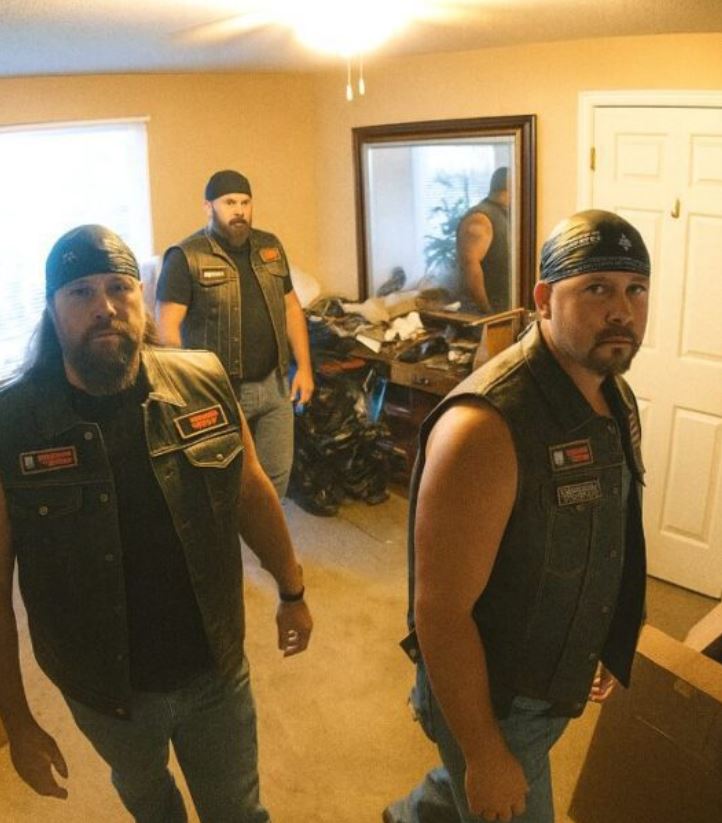
The next morning, the village woke as if someone had struck a great alarm bell.
People burst from their houses, tightening scarves around their faces, pointing at the snow, voices rising in panic. Some cried out, some whispered, some pulled their children indoors as if shielding them from an invisible danger.
Across the main road were footprints. Clear, heavy, unmistakable. Wolves had walked right through the village.
“They came for revenge!” someone cried.
“They’ll tear us apart!” another shouted.
“They’re hunting!” came a trembling voice.
But one man stood still — not frozen with fear, but with realization.
These weren’t random tracks. They didn’t swirl or wander in circles. They led in a perfectly straight line.
Directly to his house.
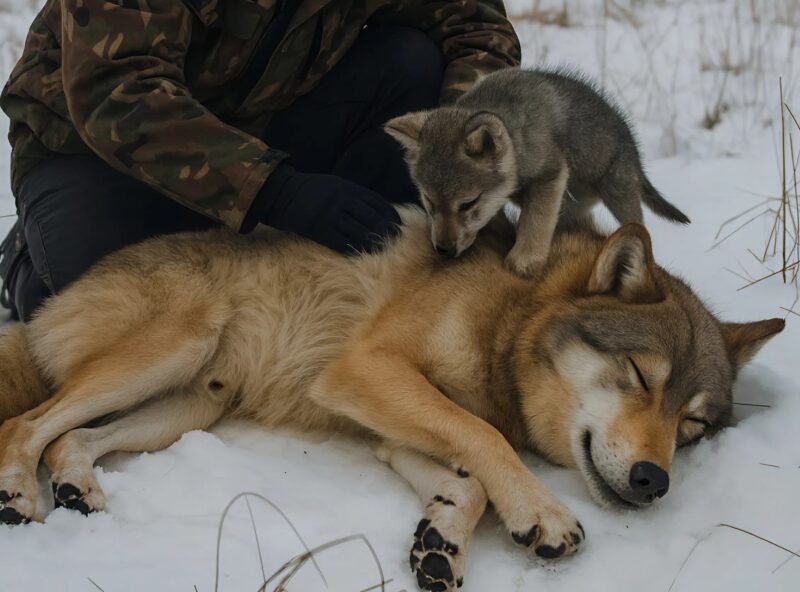
There, at his doorstep, the tracks paused. The snow showed the imprint of a body — the mother wolf had lain there for a long time. And beside her, smaller prints — hesitant steps of a pup waiting patiently.
The man stepped outside. The cold stabbed at his face, but he barely felt it. His gaze fell downward—onto something lying gently on his threshold.
A bone. Not a threat. Not a warning.
A gift.
It was part of a kill — a piece of food — an offering in the language of wolves.
A thank-you.
He whispered almost absently:
“This isn’t an attack…”
At that moment, as if in reply, a long, soft howl floated from the edge of the field. Not loud. Not fierce. More like a song than a threat.
He looked up — and there she was. The wolf he had freed. Standing calmly in the distance, her mended side rising and falling with each steady breath. And beside her — the pup, leaning slightly onto its healing paw.
The mother wolf stared at him in silence. There was no aggression in her eyes — only recognition.
“They came… to show gratitude,” he said quietly.
But the villagers weren’t listening. They were already drowning in their own terror.
“This must be stopped!”
“Call the hunters!”
“We must protect the children!”
He turned to them, and the question rose from him almost involuntarily:
“Tell me — have any of you ever seen a grateful animal?”
A neighbor scoffed:
“Grateful? It’s a wolf!”
He smiled faintly, a little sadly:
“Yes. A wolf. And when did wolves become less capable of gratitude than humans?”
His words hung in the frozen air like a breath that refused to fade.
The wolf lifted her head once more and sang a long, gentle howl — not of warning, but of acknowledgement. An invitation. A greeting.
And the man suddenly knew: that act in the snow-covered field had set in motion something bigger than he understood.
In the eyes of the villagers, he had become reckless.
But in the eyes of the wolves — he had become one of their own.
And he couldn’t shake the quiet question now echoing inside him:
between these two species — which one truly understands loyalty?